
When you’re asked, “Can you describe a time you helped someone?” during a school admission interview, it’s not just about being kind. This question reveals your empathy, maturity, and ability to reflect on your actions — all traits that international and private schools highly value.
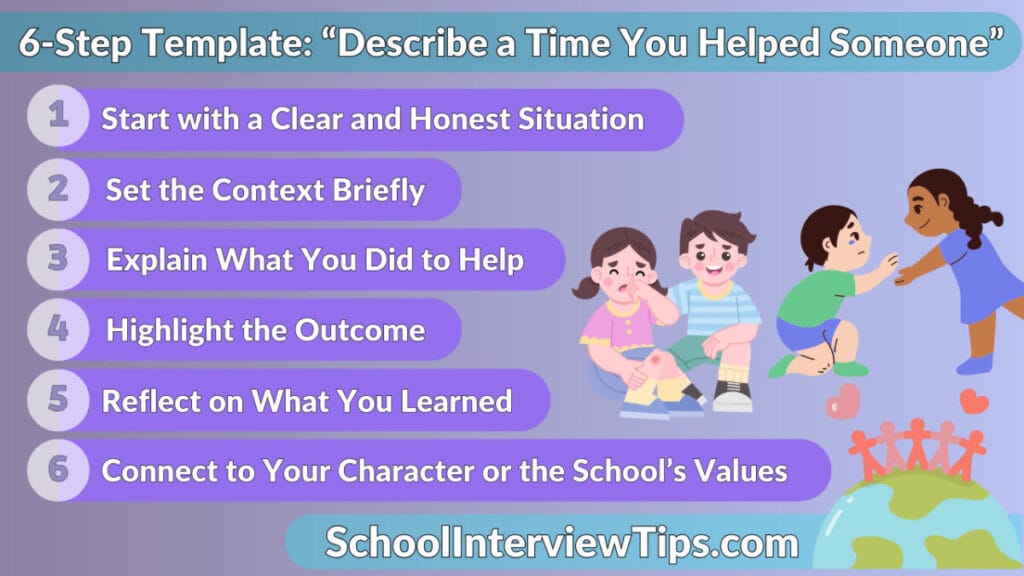
In this guide, we’ll break down exactly how to answer “Describe a Time You Helped Someone” with confidence, using a 6-step template, along with sample responses tailored by age group.
Contents
6-Step Complete Guide for School Interviews (with Sample Answers: “Describe a Time You Helped Someone”)
Step 1: Start with a Clear and Honest Situation: “Describe a Time You Helped Someone”
Pick a moment that actually happened — no need to invent something dramatic. A small but sincere moment is much more powerful than a big, vague one.
Tip: It could be something from school, home, or your daily life — like helping a friend with homework or comforting a classmate who was upset.
Step 2: Set the Context Briefly
Help the interviewer understand who needed help and why. You don’t need to explain every detail — just enough to show the situation was real and meaningful.
Example: “Last semester, my friend was struggling with math and feeling really frustrated after getting a low test score.”
Step 3: Explain What You Did to Help
This is the heart of your answer. Clearly explain your role — what you did, how you did it, and why you chose to act.
Example: “I offered to study with him after school once a week. I explained some of the practice problems using drawings and examples he could relate to.”
Step 4: Highlight the Outcome
Show that your actions made a difference, no matter how small. Schools aren’t looking for heroes — just thoughtful students who care.
Example: “After a few weeks, he started doing better and even said he felt more confident before tests.”
Step 5: Reflect on What You Learned
This is what separates a good answer from a great one. What did the experience teach you about others — or about yourself?
Example: “It taught me that even small actions, like explaining one thing more clearly, can help someone feel less alone.”
Step 6: Connect to Your Character or the School’s Values
End strong by tying this moment to a bigger idea — like empathy, leadership, or community. It shows you’re self-aware and value what the school stands for.
Example: “I like being someone others can rely on. I know your school values teamwork, and I think helping others is a big part of that.”
9 Example Answers for Different Ages
Elementary School (Grades 3–5): “Describe a Time You Helped Someone”
Example 1: Helping a New Student at Lunch
1. Situation:
“At the beginning of the school year, a new student joined our class. I noticed she was sitting alone during lunch for a few days in a row.“
2. Context:
“She looked shy and didn’t talk to anyone yet. I remembered how nervous I felt when I was new, so I wanted to help.“
3. What I Did:
“I walked over to her table and said hello. I asked if she wanted to sit with me and my friends. Then I introduced her to everyone and made sure she was included in our conversations.“
4. Outcome:
“After that day, she started eating lunch with us every day. We’ve become good friends, and now she laughs and talks more during class too.“
5. What I Learned:
“I learned that even something small, like saying hello or asking someone to join you, can make a big difference to someone else.“
6. Character Connection:
“I like helping people feel included because I know what it’s like to feel left out. I think being kind and welcoming is really important, and I try to show that every day at school.“
Example 2: Helping a Friend Understand a Class Activity
1. Situation:
“One day during science class, my friend didn’t understand the instructions for a group experiment we were doing.“
2. Context:
“He looked confused and a little embarrassed, and I could tell he didn’t want to ask the teacher in front of everyone.“
3. What I Did:
“After the teacher finished explaining, I turned to him and quietly asked if he wanted help. I explained the steps again in my own words and showed him what to do with the materials.“
4. Outcome:
“Once he understood, he was able to do his part in the experiment and even helped clean up afterward. He thanked me after class and seemed more confident the next day.“
5. What I Learned:
“I learned that helping someone doesn’t always mean doing something big—it can just be taking the time to explain things in a kind way.“
6. Character Connection:
“I think it’s important to be a good teammate and pay attention to how others are feeling. I want to be someone who notices and helps without being asked.“
Example 3: Helping a Classmate with a Lost Item
1. Situation:
“One afternoon during recess, a classmate in my grade lost her special bracelet on the playground and looked really upset.“
2. Context:
“She told me it was a gift from her grandmother and that she had just realized it had fallen off somewhere outside.“
3. What I Did:
“Even though it was free time, I offered to help her look for it. We retraced her steps around the slide, the swing area, and near the benches. After about 15 minutes, I spotted something shiny in the grass and picked it up—it was her bracelet!“
4. Outcome:
“She was so happy and gave me a big hug. Later that day, she told the teacher what happened, and the teacher thanked me for being thoughtful and helpful.“
5. What I Learned:
“I learned that taking time to help someone during a tough moment can really turn their day around.“
6. Character Connection:
“I like to be dependable and kind. I think helping someone—especially when they feel worried or sad—shows what kind of person you are inside.“
Middle School (Grades 6–8): “Describe a Time You Helped Someone”
Example 4: Helping a Group Member with Public Speaking
1. Situation:
“During an English class presentation, our group had to present a skit in front of the whole class, and one team member was really nervous about speaking.“
2. Context:
“He had never spoken in front of a group before and was afraid he would mess up or forget his lines. He even asked if he could skip his part.“
3. What I Did:
“I told him that I had felt the same way in the past and offered to practice with him during lunch. We rehearsed together several times and made flashcards to help him remember his part. I also helped rewrite his lines into simpler language he felt more confident reading.“
4. Outcome:
“On the day of the presentation, he delivered his part clearly and confidently. Our group got a good grade, and he told me afterward that he was proud of himself for doing it.“
5. What I Learned:
“I learned that encouragement and support can really help people do things they didn’t think they could. Practicing together can make a huge difference.“
6. Character Connection:
“I enjoy being someone others can rely on. I think teamwork isn’t just about finishing the project—it’s about making sure everyone feels like they belong and can succeed.“
Example 5: Helping a Friend Through a Tough Time
1. Situation:
“Last semester, one of my close friends was going through a hard time because his parents were getting divorced.“
2. Context:
“He was usually cheerful, but he started missing school, didn’t talk much, and stopped hanging out with us at lunch. I could tell something was wrong even though he wasn’t saying anything.“
3. What I Did:
“I sent him a message just to say I was thinking about him and that I was there if he wanted to talk. Later, I invited him to sit with me and our friends again and made sure he felt welcome without pressuring him. When he opened up, I just listened and didn’t try to fix things — I just let him talk.“
4. Outcome:
“After that, he slowly started spending more time with us again. He thanked me later for being there and said it helped a lot just knowing someone noticed and cared.“
5. What I Learned:
“I learned that helping someone isn’t always about solving their problems. Sometimes, just listening and being present is the most helpful thing you can do.“
6. Character Connection:
“I care deeply about my friends and try to be someone who notices when others are struggling. I think being a supportive person is just as important as being a good student.“
Example 6: Helping a New Student Adjust to School Life
1. Situation:
“Earlier this year, a new student joined our grade in the middle of the semester. He didn’t know anyone and seemed overwhelmed by the new environment.“
2. Context:
“He was quiet during classes, confused about where to go, and didn’t talk to anyone during lunch. I could tell he was having a hard time adjusting.“
3. What I Did:
“I introduced myself and offered to walk with him to his next class. I also invited him to join my lunch table and included him in a group project when we were allowed to choose our teams. I answered his questions about school rules and helped him figure out how things worked.“
4. Outcome:
“After a few weeks, he became more confident and started making his own friends. He began participating in class more, and now he says hi to me every morning in the hallway.“
5. What I Learned:
“I learned that starting at a new school can be really hard, and sometimes just one friendly person can help someone feel like they belong.“
6. Character Connection:
“I believe that kindness and inclusion matter. I want everyone to feel welcome, and I try to treat others the way I would want to be treated in a new place.“
High School (Grades 9–10): “Describe a Time You Helped Someone”
Example 7: Tutoring a Younger Student in English
1. Situation:
“Last year, I joined a school tutoring program where older students volunteer to help younger students who need extra support in English.“
2. Context:
“I was paired with a sixth grader who had recently moved from another country. He was shy and hesitant to speak during our first session because he was still building his vocabulary and confidence.“
3. What I Did:
“Instead of sticking to the workbook only, I brought simple storybooks and started with casual conversations to help him feel relaxed. I used drawings and gestures to explain words, and encouraged him to write short stories based on things he liked, like soccer and animals.“
4. Outcome:
“By the end of the semester, he was participating more in his English class and even shared one of his stories during a reading day. His teacher thanked me and said he had shown real improvement, both academically and socially.“
5. What I Learned:
“I learned that teaching isn’t just about knowing the subject — it’s about finding ways to connect, motivate, and build trust. I also realized how rewarding it is to watch someone grow because of your support.“
6. Character Connection:
“Helping others learn has helped me grow too. I value patience, empathy, and creativity in learning — and I know your school encourages those qualities in both academics and community life.“
Example 8: Organizing a Donation Drive for a Local Shelter
1. Situation:
“During the winter, I learned that a nearby shelter was in urgent need of warm clothing and supplies for families in transition.“
2. Context:
“Many people at school weren’t aware of this need, and I felt that if we worked together, we could make a real difference for the local community.“
3. What I Did:
“I spoke to a teacher about starting a donation drive and created flyers to spread the word. I organized collection boxes around the school, kept track of donated items, and worked with the student council to deliver everything to the shelter.“
4. Outcome:
“We collected over 150 items including coats, gloves, and blankets. The shelter director sent us a letter of thanks, and several students said they felt proud to be part of it.“
5. What I Learned:
“I learned that leadership starts with taking initiative — and that when you take action with purpose, others are often willing to help too. It showed me that even small efforts can lead to meaningful impact.“
6. Character Connection:
“This experience helped me grow as a leader and reinforced how much I care about service and community. I believe in acting on empathy, which is something I know your school also values deeply.“
Example 9: Helping a Friend with Anxiety During Exams
1. Situation:
“One of my close friends struggles with anxiety, and around midterms last year, she started to feel overwhelmed and emotionally shut down.“
2. Context:
“She’s usually a strong student, but the pressure of studying for multiple subjects at once became too much. She told me she was having trouble focusing and even thought about skipping one of the exams.“
3. What I Did:
“I offered to study with her—not to push her, but just to keep her company. We broke up the material into smaller parts and took breaks together. I also reminded her to talk to our counselor, and after some encouragement, she finally did.“
4. Outcome:
“She ended up taking all of her exams and did much better than she expected. Later, she told me that having someone stay calm and be there without judgment made a big difference for her.“
5. What I Learned:
“I learned that support doesn’t always have to come in the form of advice or solutions. Sometimes, just showing up, listening, and being steady can help someone get through a tough time.“
6. Character Connection:
“Empathy and emotional awareness are very important to me. I try to be the kind of person who helps others feel safe and seen—and I know your school values that kind of leadership and care.“
4 Common Mistakes to Avoid (with Examples): “Describe a Time You Helped Someone”
Mistake 1: Giving answers that are too vague
Weak Example:
“I always help my friends when they need it.”
Why It’s a Problem:
This answer is too general and doesn’t give a specific story or show what kind of help you gave. The interviewer learns nothing about your actions, personality, or values.
Fix It:
Instead, choose one specific situation and describe what you did, how you helped, and what you learned from it.
Mistake 2: Exaggerating to Sound Impressive
Weak Example:
“I once organized a charity event all by myself that raised thousands of dollars and helped hundreds of people.”
Why It’s a Problem:
If the story sounds unrealistic or overly dramatic—especially for a student—it can come across as insincere or dishonest.
Fix It:
Stick to a real, relatable situation. Small acts of kindness can be just as meaningful if told with sincerity and reflection.
Mistake 3: Skipping the Reflection Step
Weak Example:
“I helped my classmate study for a test. We worked together after school and he passed the test.”
Why It’s a Problem:
The story explains the action but stops there. It misses the opportunity to reflect on what you learned or how the experience shaped you.
Fix It:
Add a sentence or two explaining how the experience made you feel, what you discovered about yourself, or how it connects to your values.
Improved Version:
“I helped my classmate study for a test. We worked together after school and he passed. I learned that patience and teamwork can really make a difference, and I felt proud knowing I helped someone gain confidence.”
Mistake 4: Focusing too much on yourself instead of who you helped
Weak Example:
“I helped my friend with a project, and it made me feel really proud. I’m good at explaining things and I’m always a leader in group work.”
Why It’s a Problem:
This response centers on the speaker’s skills and feelings but barely mentions the person they helped or what the outcome was for that person.
Fix It:
Shift the focus to the other person’s experience—how they were impacted—and then reflect on your role more humbly.
Improved Version:
“I helped my friend with a project by walking her through the steps she didn’t understand. She ended up presenting confidently and told me afterward that she felt much better about group work. I was glad to support her and realized that helping others succeed is more rewarding than doing it all myself.”
Final Tips: Practice with Purpose: “Describe a Time You Helped Someone”
- Practice out loud but keep your tone natural.
- Use the 6-step structure to organize your answer — not memorize it word-for-word.
- Focus on sounding confident and sincere, not perfect.
Conclusion:
Answering “Describe a time you helped someone” gives you a chance to show who you really are — kind, thoughtful, and ready to grow. Use this 6-step template to prepare a strong response that feels true to you and reflects the values of the school you’re applying to.
“How Would You Contribute Our School Community?” – 5 Meaningful Answers for Different Age Groups