
How to Answer “What is Your Strength?” in a Private School Admission Interview
Facing a private school admission interview can be nerve-wracking, especially when confronted with the classic question: “What is your strength?” This seemingly simple query is actually an opportunity to showcase your unique qualities and potential contributions to the school community. Let’s break down a foolproof strategy to craft a compelling and authentic response.
Contents
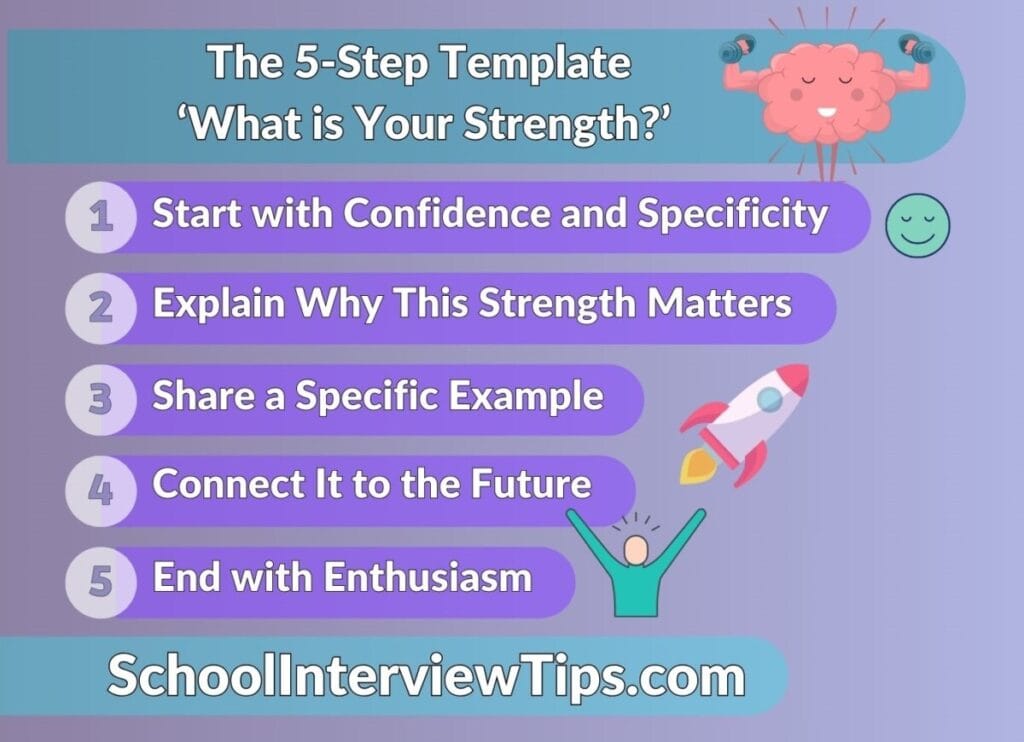
Step 1. Start with Confidence and Specificity
The key is to be precise and meaningful. Avoid generic statements like “I’m hardworking” or “I’m smart.” Instead, focus on a strength that truly sets you apart and resonates with the school’s values.
For example:
“My greatest strength is my ability to stay calm and find creative solutions under pressure.”
This approach immediately demonstrates self-awareness and a mature perspective that goes beyond surface-level attributes.
Step 2. Explain Why This Strength Matters
Context is crucial. Help the interviewer understand why this particular strength matters. Provide a brief explanation that connects the quality to broader life skills:
“This strength allows me to approach challenges with a clear mind, transforming potential obstacles into opportunities for growth and learning.”
Step 3. Share a Specific Example
Bring your strength to life with a real-life story. Use the STAR framework to organize your example.
The Science Fair Challenge
Situation: Your school science fair is about to begin, and your team’s display malfunctions.
Task: As a team member, you need to fix it quickly to ensure your project is ready for judging.
Action: You stay calm, diagnose the problem, and collaborate with teammates to find an immediate solution.
Result: “The display is fixed in time, and your team earns praise from the judges for adaptability and teamwork.“
This example demonstrates how your strength translates into real-world problem-solving, showing both initiative and resilience.
Step 4. Connect It to the Future
Private schools are investing in your future. Show how this strength will contribute to the school community:
“I’m excited to bring this problem-solving approach to group projects, collaborative challenges, and the dynamic learning environment I hope to join.”
Step 5. End with Enthusiasm
End on a note that demonstrates personal growth and forward-thinking:
“This strength is a quality I’m continuously developing. I’m eager to learn, grow, and use these skills to make meaningful contributions to my future school community.”
Pro Tips for Parents and Students
- Authenticity is Key: Choose a strength that genuinely reflects your personality.
- Practice: Rehearse your response to build confidence.
- Be Specific: Generic answers blend into the background; unique, personal stories stand out.
- Stay Positive: Focus on growth and potential, not limitations.
Common Mistakes to Avoid
- Avoid bragging or seeming overconfident
- Don’t choose a cliché strength without substantive examples
- Never suggest a “strength” that could be perceived as a weakness
- Refrain from overly rehearsed or robotic-sounding responses
3 Answers Using the 5-Step Template / Adaptability, Empathy, Sense of Humor
Strength: Adaptability
Step 1. Start with Confidence and Specificity
“My greatest strength is my adaptability, which helps me navigate new situations and thrive in changing environments.”
Why it Works:
Confidence: The statement is strong and self-assured.
Specificity: It highlights a practical, valuable skill that aligns with the dynamic nature of school life.Step 2. Explain Why This Strength Matters
“This strength allows me to embrace change and approach new opportunities with an open mind. It helps me learn quickly, adjust to new settings, and work effectively with others in unfamiliar situations.”
Why it Works:
Context: Connects the strength to real-world scenarios.
Relevance: Demonstrates qualities that schools value, such as flexibility and a positive attitude toward learning.Step 3. Share a Specific Example
S (Situation): “When my family moved to a new city last year, I had to adjust to a completely different school with new classmates and teachers.”
T (Task): “My goal was to quickly adapt to the new environment, make friends, and stay on top of my academic responsibilities.”
A (Action): “I joined the student council to meet new people, introduced myself to classmates in my first week, and asked my teachers for advice on catching up with the curriculum. I also volunteered to organize a class event, which helped me connect with others and feel part of the community.”
R (Result): “Within a month, I felt completely at home in my new school. My teachers commended me for my proactive attitude, and I made lasting friendships that helped me transition smoothly.”
Why it Works:
Specificity: The example provides clear details and demonstrates the strength in action.
Validation: The outcome (teacher commendation and friendships) supports the claim.Step 4. Connect It to the Future
“I know that [School Name] offers many opportunities to grow academically and personally. My adaptability will help me embrace new challenges, engage in diverse activities, and collaborate with classmates from different backgrounds.”
Why it Works:
Relevance: Links the strength to the school’s values and environment.
Contribution: Shows how the student’s skill will benefit the school community.Step 5. End with Enthusiasm
“This is a skill I’ve developed through experiences like moving to a new school, and I’m excited to continue using it to adapt, learn, and contribute at [School Name].”
Why it Works:
Optimism: Leaves a positive impression.
Growth-Oriented: Highlights the student’s desire to continue developing this strength.
Strength: Empathy
Step 1. Start with Confidence and Specificity
“My greatest strength is my empathy, which allows me to understand others’ feelings and perspectives and build strong, meaningful connections.”
Why it Works:
Confidence: Shows self-awareness and assurance in your ability.
Specificity: Focuses on empathy, a highly valued trait in teamwork and leadership.Step 2. Explain Why This Strength Matters
“This strength enables me to create a supportive environment, whether I’m helping a classmate through a challenge or collaborating with others on a group project.”
Why it Works:
Context: Demonstrates the practical applications of empathy in academic and social settings.
Impact: Highlights its value in fostering collaboration and mutual understanding.Step 3. Share a Specific Example
S (Situation): “Last year, during a group project in history class, one of my teammates was struggling to contribute because they were going through a tough time at home.”
T (Task): “As the group leader, I wanted to ensure that everyone felt included and supported, even if they couldn’t fully participate.”
A (Action): “I took the time to talk with them privately to understand what they were going through and offered to reassign smaller, more manageable tasks. I also encouraged the rest of the group to be understanding and supportive, creating a positive atmosphere.”
R (Result): “Our team completed the project successfully, and my teammate expressed their gratitude for feeling included. The teacher even commended our group for our teamwork and camaraderie.”
Why it Works:
Specificity: The example clearly illustrates the practical use of empathy.
Impact: The outcome reinforces the value of the strength.Step 4. Connect It to the Future
“I’m excited to bring this empathetic approach to [School Name], whether it’s supporting peers in group projects, contributing to a welcoming school environment, or working together to achieve common goals.”
Why it Works:
Relevance: Aligns empathy with teamwork and the school’s community values.
Contribution: Demonstrates how the strength will benefit others.Step 5. End with Enthusiasm
“Empathy is a quality I’m always working to develop. I believe it’s essential not just for academic success, but for building meaningful relationships and contributing to a positive school community.”
Why it Works:
Optimism: Leaves a lasting impression.
Growth-Oriented: Shows a commitment to personal development.
Strength: Sense of Humor
Step 1. Start with Confidence and Specificity
“My greatest strength is my sense of humor, which helps me connect with others, create a positive atmosphere, and lighten tense situations.”
Why it Works:
Confidence: Demonstrates pride in a unique and personal strength.
Specificity: Shows how humor is more than entertainment—it’s a tool for connection and emotional intelligence.Step 2. Explain Why This Strength Matters
“This strength allows me to navigate challenging situations with optimism, put others at ease, and build stronger relationships. It helps me keep a positive perspective, even during tough times.”
Why it Works:
Context: Explains the practical benefits of humor.
Relevance: Demonstrates emotional intelligence and leadership potential.Step 3. Share a Specific Example
S (Situation): “During our group project for history class, the deadline was approaching, and everyone was feeling stressed about finishing on time.”
T (Task): “As the group leader, I needed to motivate my teammates, keep morale high, and ensure we stayed productive.”
A (Action): “I used humor to lighten the mood during our late-night study session, making jokes about our overly detailed timeline of historical events. I also introduced a friendly competition to see who could come up with the most creative titles for our presentation slides, which turned into a fun brainstorming session.”
R (Result): “The team’s mood lifted, and we worked more efficiently. We completed the project on time, received an A, and our teacher even complimented us on the presentation’s creativity and energy.”
Why it Works:
Specificity: Highlights how humor was applied effectively in a real situation.
Impact: Demonstrates tangible results and positive outcomes.Step 4. Connect It to the Future
“I’m excited to bring this strength to [School Name], whether it’s fostering teamwork, creating a welcoming environment, or participating in school events like theater productions or student leadership initiatives.”
Why it Works:
Forward-Thinking: Links humor to community engagement and collaboration.
Contribution-Oriented: Shows how the strength will benefit others.Step 5. End with Enthusiasm
“I believe a sense of humor is a strength that can bring people together and make even challenging situations more manageable. I’m eager to use this skill to contribute to a positive and supportive school environment, while continuing to learn and grow with my peers.”
Why it Works:
Optimism: Leaves a lasting, positive impression.
Growth-Oriented: Shows commitment to using humor constructively.
Final Thoughts
The “greatest strength” question is more than a standard interview query—it’s an opportunity to tell your story, showcase your character, and demonstrate why you’re an exceptional candidate for the school.
Remember, the goal isn’t to impress with perfection, but to reveal your potential for growth, contribution, and personal development.
Good luck with your interview!
The 6-Step Template to Master ‘Tell Me About Yourself’
