
Learn how to answer the common private school interview question about historical figures. Includes a 6-step template and sample answer featuring Leonardo da Vinci.
Contents
Why Do Schools Ask This Question?
Private school admission interviews often include the question “If you could meet any historical figure, who would it be and why?” This isn’t just a casual conversation starter. Admissions officers use this question to evaluate several key qualities in potential students:
- Critical thinking and analytical skills
- Knowledge of history and current events
- Ability to make meaningful connections
- Personal values and interests
- Communication and storytelling abilities
Understanding why schools ask this question helps you craft a more thoughtful and compelling response.
6-Step Answer Template
Step 1: Introduction
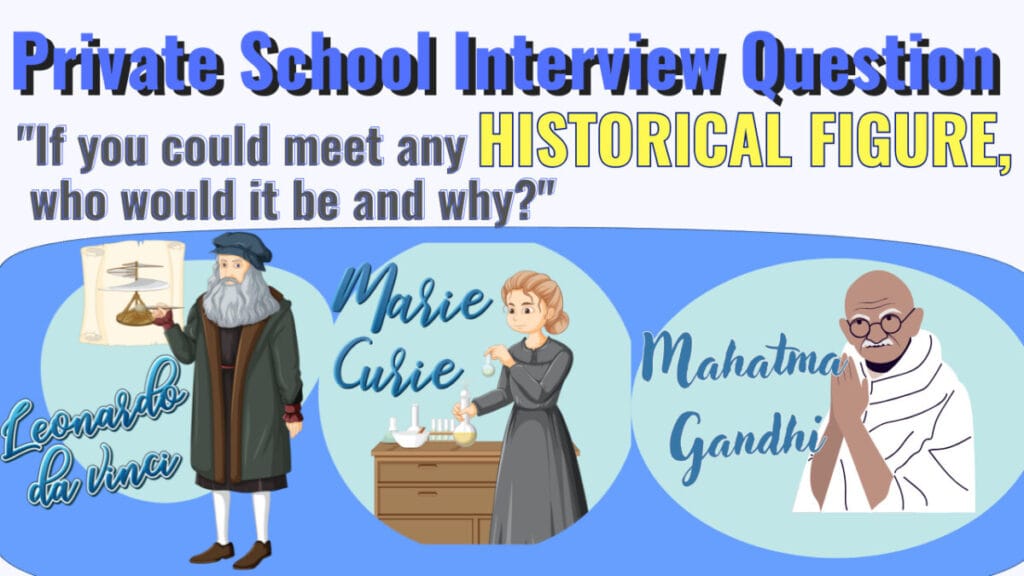
Start by briefly restating the question and naming your chosen historical figure. Keep your initial response clear and confident.Leonardo da Vinci.((Renaissance Innovation & Interdisciplinary Genius)
Example:
“If I could meet any historical figure, I would choose Leonardo da Vinci. As a Renaissance polymath who excelled in both arts and sciences, he represents the kind of well-rounded education I aspire to achieve.
Step 2: Historical Context
Provide relevant background information about your chosen figure. Include:
- Time period they lived in
- Major accomplishments
- Historical significance
- Impact on society
Example:
“Da Vinci lived from 1452 to 1519, during the height of the Italian Renaissance. While many know him for masterpieces like the Mona Lisa and The Last Supper, his contributions extended far beyond art. His detailed anatomical studies advanced medical understanding, and his engineering designs prefigured modern inventions like helicopters and tanks. His notebooks contain thousands of pages of observations and inventions that were centuries ahead of their time.“
Step 3: Personal Connection
Explain why this particular figure resonates with you. Connect their qualities or achievements to your own:
- Personal interests
- Academic goals
- Values
- Future aspirations
Example:
“I’m particularly drawn to da Vinci because he refused to accept conventional boundaries between disciplines. As someone who loves both laboratory experiments and creative writing, I admire how he combined artistic vision with scientific precision. His anatomical drawings weren’t just accurate—they were beautiful. His engineering designs weren’t just functional—they were innovative works of art.“
Step 4: Learning Opportunity
Describe what you would hope to gain from meeting this person:
- Specific questions you would ask
- Skills or knowledge you would seek
- Insights you would value
Example:
“If I could spend time with him, I would ask about his process of observation. How did he develop such keen attention to detail? I would love to understand how he approached problems from multiple angles, finding connections between seemingly unrelated fields. I imagine showing him a modern microscope or computer, seeing his eyes light up at how technology has evolved from his initial concepts.“
Step 5: Modern Relevance
Connect the historical figure’s influence to contemporary life:
- Current applications of their ideas
- Ongoing impact of their work
- Lessons still relevant today
- Personal application in your life
Example:
“Da Vinci’s approach to learning influences how I study today. When working on science projects, I take detailed notes and sketches, inspired by his meticulous documentation. In art class, I study the underlying structure of subjects before drawing them, just as he studied anatomy to improve his paintings. His example shows that true innovation comes from crossing traditional boundaries between subjects.“
Step 6: Memorable Conclusion
End with a strong closing statement that ties everything together and reinforces your choice.Example:
“Meeting Leonardo da Vinci would be invaluable because he embodies the ideal of lifelong learning that I strive to follow. His legacy teaches us that curiosity, observation, and creativity are timeless tools for understanding our world.”
Common Mistakes to Avoid
- Choosing controversial figures without careful consideration
- Providing only surface-level knowledge about the historical figure
- Failing to make personal connections
- Giving generic or predictable answers
- Focusing too much on facts and not enough on impact
Tips for Success
- Research your chosen figure thoroughly
- Practice articulating your reasons clearly
- Include specific examples and details
- Show genuine enthusiasm
- Connect your answer to your academic interests
Frequently Asked Questions
Q: How long should my answer be?
A: Aim for 2-3 minutes of speaking time, or about 250-300 words if written.
Q: Should I memorize my answer word-for-word?
A: No, memorize key points but keep the delivery natural and conversational.
Q: Can I choose a current figure instead?
A: Stick to historical figures who are no longer living to demonstrate historical knowledge.
Q: What makes a good historical figure choice?
A: Choose someone whose achievements or values align with your interests and the school’s values, and whose legacy is generally positive and inspiring.
Key Takeaways
- Choose a historical figure whose legacy aligns with your interests and values
- Structure your answer to show both knowledge and personal connection
- Include specific examples and details to make your answer memorable
- Practice your delivery to sound natural and engaged
- Connect your choice to your academic goals and personal growth
School interview question about historical figure:
Marie Curie (Radioactivity Research & Scientific Persistence)
“If I could meet any historical figure, I would choose Marie Curie. As a pioneering female scientist who revolutionized our understanding of radioactivity and became the first person to win two Nobel Prizes in different sciences, she represents the dedication to scientific discovery and perseverance that I admire.
Marie Curie lived from 1867 to 1934, during a transformative period in scientific history. She discovered two new elements – polonium and radium – and developed the theory of radioactivity. What makes her achievements even more remarkable is that she succeeded in a male-dominated field at a time when women were rarely accepted in scientific circles. She conducted her groundbreaking research while working in challenging conditions, often in a converted shed, and became the first female professor at the Sorbonne University in Paris.
I’m particularly inspired by Madame Curie because she combined scientific brilliance with unwavering determination. As a young woman passionate about chemistry and physics, I see in her story a powerful example of how dedication to science can overcome societal barriers. Her commitment to using her discoveries to help others, especially her development of mobile X-ray units during World War I, shows how scientific research can have profound humanitarian impacts.
If I had the opportunity to meet her, I would ask about her research methodology. How did she maintain her dedication during years of painstaking work? I would be fascinated to learn about her perspective on the role of women in science and how she balanced her groundbreaking research with her role as a mother of two daughters, who themselves became accomplished scientists. I would also love to show her how her discoveries led to modern cancer treatments and medical imaging technologies.
Marie Curie’s influence shapes my approach to academics today. When facing challenging problems in my physics and chemistry classes, I remember her persistence in isolating radium – a process that took four years of processing tons of pitchblende ore. Her example teaches me that significant discoveries require patience, precision, and resilience. I’m particularly inspired by how she shared her findings openly with the scientific community, never patenting her discoveries because she believed they belonged to everyone.
Meeting Marie Curie would be extraordinary because she exemplifies how scientific curiosity, combined with unwavering determination, can advance human knowledge and benefit society. Her legacy reminds us that groundbreaking discoveries often require courage to challenge conventional wisdom and dedication to pursue truth, regardless of obstacles.”
School interview question about historical figure:
Mahatma Gandhi (Nonviolent Resistance & Indian Independence)
“If I could meet any historical figure, I would choose Mahatma Gandhi. As the leader of India’s non-violent independence movement and a global symbol of peaceful resistance, he demonstrated how individual actions can spark transformative social change.
Gandhi lived from 1869 to 1948, leading India’s independence movement against British colonial rule. What fascinates me most is that he achieved massive social change without using violence. Through methods like civil disobedience, peaceful protests, and his famous Salt March, he showed that moral courage could be more powerful than physical force. His philosophy of ‘ahimsa’ (non-violence) influenced other leaders like Martin Luther King Jr. and Nelson Mandela.
I’m drawn to Gandhi because he lived by his principles, no matter the personal cost. As someone who leads my school’s debate club and conflict resolution program, I’m inspired by his ability to negotiate and find peaceful solutions to complex problems. His famous quote, ‘Be the change you wish to see in the world,’ guides my approach to community service and leadership.
If I could meet him, I would ask about maintaining inner peace during times of conflict. How did he stay committed to non-violence when faced with aggressive opposition? I would be particularly interested in his thoughts on using these principles in today’s digital age, where conflicts often play out on social media.
Gandhi’s teachings influence how I handle disagreements in my daily life. When facing conflicts in student council or during debate competitions, I try to understand opposing viewpoints and find common ground. His emphasis on simple living and high thinking has inspired me to start a minimalism club at school, encouraging students to focus on what truly matters.
Meeting Gandhi would be invaluable because his message of peaceful change and personal integrity is more relevant than ever in our divided world. His example shows that true leadership begins with self-transformation.”