
How to Answer ‘Tell Me About Yourself’ with Confidence and Clarity
Contents
See a Complete Sample Answer and Watch the 6-Step Template in Action!
Below, you’ll find a complete sample answer crafted using the 6-step template, along with a video demonstration to show how to deliver it effectively. If you’re looking for a detailed breakdown of each step, don’t worry—it’s all explained in full later in this post. Use this as a guide to craft your own personalized response!
Sample Answer
Step 1: Opening Statement
Who You Are
“Hi, my name is Sophia Johnson, and I’m 12 years old. I’m currently in 7th grade at Maplewood Middle School, where I’ve been exploring my interests in science, art, and student leadership. One thing that stands out about me is my curiosity—I love asking questions and learning how things work, which has driven me to try new things both in and out of school.”
Step 2: Academic Interests
What You Like at School
“My favorite subject in school is science because I enjoy hands-on experiments and figuring out how theories apply to real life. Last semester, I worked on a group project about renewable energy, where we built a small solar-powered car. It was exciting to see how our design came to life, and it made me even more interested in pursuing STEM fields in the future.”
Step 3: Hobbies and Extra-curricular Activities
What You Do Outside of School
“Outside of class, I enjoy drawing and painting because it allows me to express my creativity. I’m also part of the debate club, where I’ve learned how to present my ideas clearly and listen to others’ perspectives. Recently, I participated in a school-wide debate competition, and our team came in second place, which was a great experience.”
Step 4: Personal Qualities and Values
Who You Are as a Person
“People often describe me as hardworking and curious. I enjoy tackling challenges and finding solutions, whether it’s solving a tough math problem or brainstorming new ideas for an art project. I’m also a good team player because I believe collaboration brings out the best in everyone. For example, during our solar car project, I helped coordinate tasks and made sure every teammate’s ideas were heard, which made our project stronger.”
Step 5: Future Goals
What You’re Excited About
“In the future, I hope to explore more about environmental science and learn how technology can help solve problems like climate change. I’d also like to develop my art skills further, maybe even create illustrations that help explain scientific concepts in a fun and creative way.”
Step 6: Closing Statement
Wrap Up Positively
“I’m really excited about this opportunity to share more about myself and hear your thoughts as well. I look forward to learning how I can contribute to this school’s community and grow through all the amazing opportunities here.”
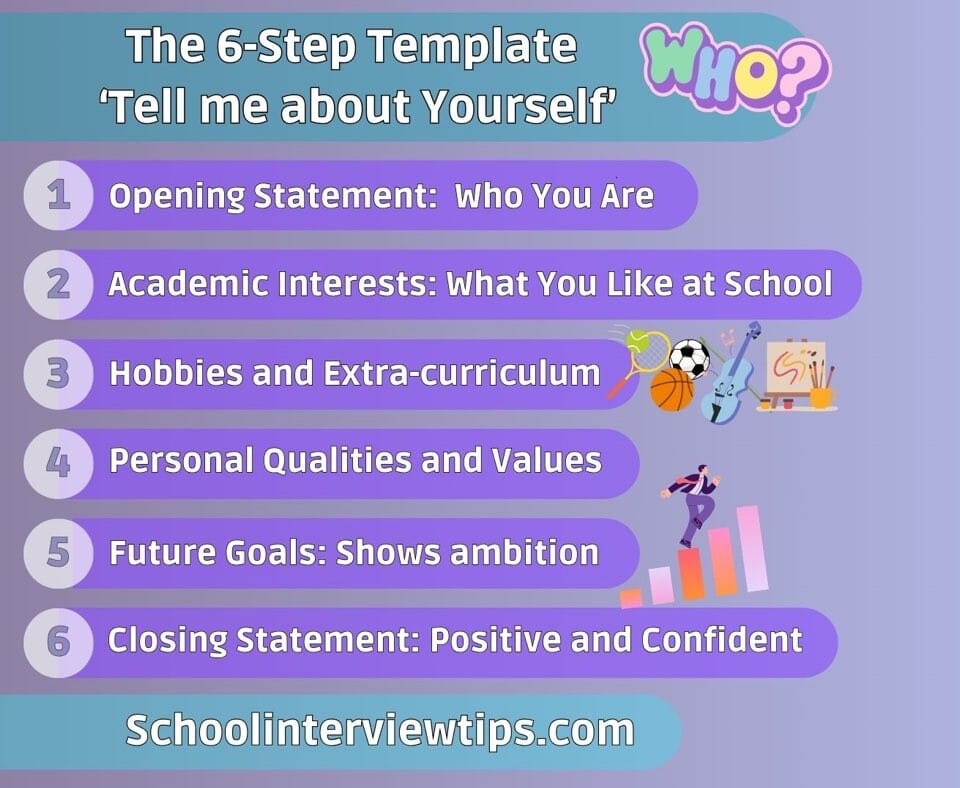
Now, Let’s Break It Down Step by Step
In the video above, you saw a complete example answer to the question, “Tell me about yourself,” using the 6-step template. Each step is carefully designed to help you structure your response and highlight your strengths in a natural and engaging way. In the sections below, we’ll take a closer look at each step, providing tips, examples, and insights to help you craft your own unique answer with confidence.
Step 1: Opening Statement:
- Who You Are
- Start with your name, age, and grade.
- Mention your school and any unique aspect of your background.
20 Examples of Opening Statements
1. Simple and Friendly
“Hi, my name is [Name], and I’m [Age] years old. I’m currently in the [Grade] th grade at [School Name], and I’m excited to share a little about myself with you today.”2. Highlighting Enthusiasm
“Hello, I’m [Name], a [Age]-year-old [Grade]th grader at [School Name]. I’ve always loved exploring new things, both in and out of the classroom, and I’m excited about the opportunity to be here today.”3. Introducing a Key Trait
“Hi, my name is [Name]. I’m [Age] years old and in the [Grade]th grade at [School Name]. One thing people often say about me is that I’m curious, and I think that’s true because I love learning about the world around me.”4. Connecting to Interests
“Hello, I’m [Name], and I’m [Age] years old. I’m a [Grade]th grader at [School Name], where I’ve been exploring my favorite subjects like [Favorite Subject], which has inspired me to think about my future goals.”5. Focusing on Growth
“Hi, my name is [Name], and I’m [Age] years old. I’m currently in [Grade]th grade at [School Name]. Over the years, I’ve discovered my love for [Subject or Activity], and I’m looking forward to sharing how it’s helped me grow.”6. Starting with a Unique Fact
“Hello, I’m [Name], and I’m [Age] years old. A fun fact about me is that I’ve lived in three different cities, which has helped me become adaptable and open to new experiences.”7. Mentioning a Recent Achievement
“Hi, I’m [Name], and I’m [Age] years old. I’m in [Grade]th grade at [School Name], and one of my proudest moments this year was winning [Award/Competition], which I’m excited to tell you more about.”8. Personalizing to the Interview
“Hello, my name is [Name], and I’m [Age] years old. I’m currently in [Grade]th grade at [School Name]. I’m really excited about this opportunity to share my story and learn more about your school.”9. Highlighting Future Aspirations
“Hi, I’m [Name], and I’m [Age] years old. I’m in [Grade]th grade at [School Name], where I’m working hard to explore my interests, like [Interest], as I think about my goals for the future.”10. Starting with Enthusiasm for the Opportunity
“Hello, I’m [Name], a [Age]-year-old [Grade]th grader at [School Name]. I’m thrilled to have this opportunity to tell you about my interests, experiences, and what I hope to achieve in the future.”11. Multicultural Background
“I come from a multicultural family, so I’ve grown up speaking both [Language] and [Language] at home, and I love learning about different cultures.”12. Relocation or Living Abroad
“I recently moved from [City/Country], and it’s been exciting to adapt to a new school and make new friends while learning about a different place.”13. Family Tradition or Skill
“My family has a tradition of gardening, and I’ve learned a lot about growing vegetables and flowers from my grandparents.”14. Unique Hobby or Talent
“I’ve been practicing origami since I was 7, and I enjoy creating intricate designs like animals and flowers.”15. Personal Achievement
“I won a regional [Spelling Bee/Art Competition/Science Fair] last year, and it inspired me to keep working hard in that area.”16. Community Involvement
“I’ve volunteered with my family at a local animal shelter, and I love helping take care of the animals and learning about how to support them.”17. Educational Experience
“Last year, I participated in an online coding camp, where I learned to create my first app. It was challenging but exciting.”18. Exposure to Music or Art
“Music is a big part of my family—my mom plays the piano, and I’ve been learning to play the violin for three years.”19. Sports or Outdoor Experiences
“My family loves hiking, and we’ve visited some amazing trails, like [Name of Place], where I learned how to read trail maps and appreciate nature.”20. Unusual Passion or Interes
“I have a passion for astronomy, and I’ve built my own telescope with my dad so I can explore the stars and planets from home.”
How to Use These Examples
Choose one that feels natural and authentic to yourself
Briefly explain why it’s meaningful or interesting.
Tie it into your personality, values, or curiosity.
Tips
Be Confident: Use positive and friendly language.
Show Enthusiasm: Reflect genuine excitement about the opportunity.
Personalize: Include a specific detail, such as an interest, achievement, or trait that stands out.
Keep it Concise: Ensure the statement is brief but sets the tone for the rest of the response.
Step 2: Academic Interests
- What You Like at School
- Talk about your favorite subjects and why you enjoy them.
- Highlight something unique, such as a project, club, or event you participated in
10 Examples of Favorite Subjects and Why
1. Science
“I love science because it helps me understand how the world works. I enjoy doing experiments, like testing how plants grow in different conditions, and learning about the environment.”2. Mathematics
“Math is my favorite subject because I like solving problems and figuring out puzzles. I enjoy the feeling of accomplishment when I find the correct solution.”3. English
“I enjoy English because I love reading stories and writing my own. Creative writing lets me express my imagination, and reading helps me learn about different places and ideas.”4. History
“History is my favorite subject because it’s fascinating to learn about the people and events that shaped our world. I especially enjoy studying ancient civilizations like Egypt and Rome.”5. Art
“I love art because it allows me to be creative and express my thoughts and emotions. Painting and drawing are ways for me to relax and explore new ideas.”6. Physical Education (P.E.)
“P.E. is my favorite subject because I enjoy staying active and playing sports like basketball and soccer. It also teaches me teamwork and how to stay healthy.”7. Music
“I enjoy music because it’s fun to play instruments and learn how they work together to create songs. I’ve been learning the guitar, and it’s exciting to see my progress.”8. Computer Science
“Computer science is my favorite subject because I enjoy learning about technology and coding. I recently created a small game, and it made me want to learn even more.”9. Geography
“I love geography because it helps me learn about different countries, cultures, and landscapes. It’s exciting to imagine traveling to all the places we study in class.”10. Drama
“Drama is my favorite subject because it allows me to step into different characters and tell stories through acting. It’s also helped me become more confident speaking in front of others.”
How to Personalize These Examples
Add a specific experience:
“In math, I enjoyed working on a project where we had to design a budget for a family trip.”
Tie it to a broader interest:
“I love art, and I hope to one day become a graphic designer or illustrator.”
Step 3: Hobbies and Extra-curriculum
- Gives a glimpse of your passions outside academics.
- Share your hobbies or after-school activities that you are passionate about.
- Highlight what you’ve learned or achieved through these activities.
20 Examples of Hobbies or After-School Activities and What You’ve Learned
1. Playing a Musical Instrument
What you’ve learned:
“I’ve learned discipline and patience from practicing the piano every day.”
“I performed in my school’s winter recital, which boosted my confidence.”2. Reading
What you’ve learned:
“Reading has expanded my vocabulary and taught me to think critically about stories and characters.”
“I completed a 50-book reading challenge and discovered my love for historical fiction.”3. Soccer
What you’ve learned:
“I’ve developed teamwork and leadership skills while playing as the captain of my soccer team.”
“We won our district championship last year, which taught me perseverance.”4. Drawing or Painting
What you’ve learned:
“Art has taught me creativity and how to express my emotions visually.”
“I submitted a painting to a local contest and won first place.”5. Chess
What you’ve learned:
“Playing chess has improved my strategic thinking and problem-solving skills.”
“I competed in a school tournament and placed second.”6. Dance
What you’ve learned:
“Dancing has helped me build confidence and improve my coordination.”
“I performed a solo during our school’s cultural festival.”7. Writing Stories or Poetry
What you’ve learned:
“Writing has taught me how to organize my thoughts and express myself creatively.”
“One of my poems was published in our school’s literary magazine.”8. Gardening
What you’ve learned:
“Gardening has taught me responsibility and patience as I care for plants and watch them grow.”
“I grew vegetables in our school garden and helped donate them to a local food pantry.”9. Cooking or Baking
What you’ve learned:
“I’ve learned to follow instructions carefully and measure ingredients accurately.”
“I baked cupcakes for a school fundraiser, and it was a big success!”10. Coding
What you’ve learned:
“Coding has taught me logical thinking and how to troubleshoot problems.”
“I created a simple app that tracks daily homework tasks.”11. Martial Arts
What you’ve learned:
“Martial arts have taught me self-discipline and focus.”
“I earned my green belt and learned how to set and achieve goals.”12. Photography
What you’ve learned:
“Photography has helped me see the world from new perspectives and pay attention to details.”
“I took photos for our school yearbook and received great feedback.”13. Volunteering at an Animal Shelter
What you’ve learned:
“Volunteering has taught me compassion and how to care for animals in need.”
“I helped organize an adoption event that found homes for 10 pets.”14. Swimming
What you’ve learned:
“Swimming has taught me perseverance and how to set personal records.”
“I competed in my first swim meet and improved my time by 10 seconds.”15. Drama or Theater
What you’ve learned:
“Drama has helped me improve my public speaking and teamwork skills.”
“I performed in a school play, which helped me overcome stage fright.”16. Coding/Robotics Club
What you’ve learned:
“I’ve learned how to work with a team to build robots and code them to complete tasks.”
“Our team won a prize at a local robotics competition.”17. Playing Board Games
What you’ve learned:
“Board games have taught me strategy and how to stay calm under pressure.”
“I introduced my family to a new game and hosted a game night at home.”18. Bird Watching or Nature Exploring
What you’ve learned:
“Bird watching has taught me patience and how to appreciate the environment.”
“I identified over 20 species of birds in my local park and started a journal about them.”19. Running or Track and Field
What you’ve learned:
“Running has taught me resilience and how to push myself to achieve personal bests.”
“I ran my first 5K and placed in the top 10 for my age group.”20. Knitting or Crafting
What you’ve learned:
“Knitting has taught me focus and how to be patient with long-term projects.”
“I made scarves to donate to a local homeless shelter.”
How to Use These Examples
- Pick activities that you genuinely enjoys and can discuss with enthusiasm.
- Highlight specific skills, lessons, or achievements that show personal growth.
- Tie the activity back to values like perseverance, creativity, or teamwork.
- Example:
“In my free time, I enjoy [Hobby/Activity], like playing the guitar, drawing, or playing soccer. For example, I’ve been learning guitar for two years, and I love playing songs for my family. I’m also part of the [Club/Team], where I’ve made great friends and learned teamwork.”

Step 4: Personal Qualities and Values
- Reflects your personality and what you stand for.
- Share positive traits that describe your personality.
- Explain how these traits help you in school or your hobbies.
10 Examples of Positive Traits
1. Curious
Trait: “I’m naturally curious and love asking questions about how things work.”
How it helps: “This helps me in science class because I enjoy exploring experiments and understanding the reasoning behind scientific concepts.”Example:
“People often say I’m curious and hardworking. I think that’s true because I love asking questions and trying to improve at whatever I do, whether it’s finishing a tricky math problem or practicing for a piano recital.”2. Hardworking
Trait: “I’m very hardworking and always put in extra effort to do my best.”
How it helps: “In soccer, I stay after practice to work on my skills, which has helped me improve and become a better player.”Example:
“People often say I’m hardworking and determined. I think that’s true because I always put in extra effort to improve, whether it’s staying after soccer practice to work on my skills or spending extra time reviewing my notes to prepare for a big test.3. Creative
Trait: “I’m a creative person who enjoys coming up with new ideas.”
How it helps: “This helps me in art class, where I can think outside the box and create unique projects that stand out.”Example:
“People often say I’m creative and imaginative. I think that’s true because I love coming up with new ideas, whether it’s designing a unique art project for class or finding a fun way to solve a problem during group work.”4. Organized
Trait: “I’m very organized, and I like keeping track of my tasks and responsibilities.”
How it helps: “In school, I use a planner to manage homework and projects, which helps me stay on top of deadlines and avoid feeling overwhelmed.”Example:
“People often say I’m organized and dependable. I think that’s true because I like keeping track of my tasks with a planner, whether it’s managing my homework assignments or planning ahead for group projects. It helps me stay focused and meet deadlines without feeling stressed.”5. Patient
Trait: “I’m patient and willing to take my time to learn something new.”
How it helps: “This is useful when I’m practicing guitar because it takes time to perfect a song, and I don’t give up when it gets challenging.”Example:
“People often say I’m patient and persistent. I think that’s true because I’m willing to take my time to learn something new, whether it’s practicing a difficult song on the guitar or working through a challenging math problem. I don’t give up easily, and I enjoy the process of improving step by step.”6. Team Player
Trait: “I’m a team player who enjoys working with others toward a common goal.”
How it helps: “In group projects at school, I help coordinate tasks and ensure everyone’s ideas are included, which makes our work better.”Example:
“People often say I’m a team player and collaborative. I think that’s true because I enjoy working with others, whether it’s helping to organize tasks during group projects or supporting my teammates on the soccer field. I believe listening to everyone’s ideas and contributing my own makes our work stronger and more successful.”7. Determined
Trait: “I’m very determined and don’t give up easily when something is difficult.”
How it helps: “In math, I keep working on problems even if they’re tricky, and I ask for help when needed to fully understand.”Example:
“People often say I’m determined and persistent. I think that’s true because I don’t give up easily, whether it’s solving a tricky math problem or practicing until I master a new skill in basketball. I always push myself to improve and achieve my goals.”8. Friendly
Trait: “I’m friendly and enjoy meeting new people and building relationships.”
How it helps: “This helps me in debate club because I can collaborate with teammates and communicate effectively with others during competitions.”Example:
“People often say I’m friendly and approachable. I think that’s true because I enjoy meeting new people and building relationships, whether it’s working with teammates in debate club or helping classmates during group activities. Being friendly helps me connect with others and communicate effectively.”9. Detail-Oriented
Trait: “I’m detail-oriented and like making sure everything is done accurately.”
How it helps: “In my coding hobby, I pay attention to small errors, which helps me troubleshoot and create functioning programs.”Example:
“People often say I’m detail-oriented and thorough. I think that’s true because I pay close attention to small details, whether it’s spotting errors in my coding projects or double-checking my work in school assignments. This helps me ensure everything is accurate and works as it should.”10. Responsible
Trait: “I’m responsible and take my commitments seriously.”
How it helps: “In student council, I make sure to complete my assigned tasks, like organizing events, which helps the team achieve our goals.”Example:
“People often say I’m responsible and reliable. I think that’s true because I always take my commitments seriously, whether it’s completing my tasks in student council or staying prepared for group projects. I enjoy knowing that others can count on me to get things done effectively.”
How to Use These Examples
- Choose traits that feel authentic and align with the student’s experiences.
- Provide specific examples of how these traits help in school or hobbies to make the answer more relatable and engaging.
- Avoid listing traits without context—focus on one or two and explain their impact.
Step 5: Future Goals
- Shows ambition and forward-thinking.
- Mention what you’re excited about learning or achieving in the future.
- Keep it relevant and age-appropriate.
Example:
“In the future, I hope to learn more about [Subject/Field], like [Example: technology, sports, or art]. I think it would be exciting to use my interests to help others or create something new.”
20 Examples of What You’re Excited About Achieving in the Future
1. Learning a New Language
“I’m excited to learn Spanish because I want to travel to Spanish-speaking countries and connect with people in their native language.”2. Mastering an Instrument
“I hope to master the guitar and play a solo in a school concert someday.”3. Advancing in Science
“I want to explore more about space and learn how scientists are working on space exploration, like missions to Mars.”4. Improving Writing Skills
“I’d love to write a short story or even a book that gets published in a school magazine or online.”5. Developing Leadership Skills
“I’m excited to join the student council and learn how to lead and organize events for my school.”6. Joining a Competitive Sports Team
“I want to improve my soccer skills and make it to my school’s varsity team.”7. Gaining Coding Knowledge
“I’m excited to learn how to code and create my own app or game that people can use.”8. Participating in a Debate Competition
“I’d like to join the debate club and represent my school in a regional competition.”9. Exploring Robotics
“I hope to join a robotics team and build a robot that can solve real-world problems.”10. Creating Art for an Exhibition
“I’d love to create a painting or sculpture and have it displayed in a local art gallery.”11. Studying Environmental Science
“I’m interested in learning how to reduce plastic waste and make a positive impact on the environment.”12. Traveling Abroad for Education
“I’m excited about participating in an exchange program to experience a different culture and way of learning.”13. Improving Public Speaking Skills
“I want to become a more confident speaker and participate in a public speaking competition.”14. Building a Science Project
“I’d like to design a working model of a sustainable house for a school science fair.”15. Becoming Fluent in Math
“I’m excited to take on more challenging math problems and maybe participate in a math competition.”16. Learning Photography
“I want to learn how to take professional photos and create a portfolio of my work.”17. Making a Positive Impact in the Community
“I’d like to start a recycling program in my neighborhood and involve my school in the initiative.”18. Excelling in Drama
“I hope to land a lead role in a school play and learn more about acting techniques.”19. Exploring Entrepreneurship
“I’m excited to learn how to start a small business and create a product or service that helps people.”20. Achieving Academic Excellence
“I want to challenge myself to maintain good grades while exploring more advanced topics in my favorite subjects, like history and biology.”
How to Use These Examples
- Tailor the goals to fit your genuine interests and aspirations.
- Provide context to explain why the goal excites you or how it aligns with your passions.
- Show enthusiasm and curiosity for growth and learning.
Step 6: Closing Statement
- Wraps up the response positively and confidently.
20 Examples of Closing Statements
1. Expressing Enthusiasm
“Thank you so much for this opportunity. I’m really excited about the chance to learn and grow here, and I hope to contribute my best to your school.”2. Showing Gratitude
“I appreciate your time today. It was great sharing my experiences, and I hope to bring my enthusiasm and dedication to your school.”3. Highlighting Interest
“I’ve really enjoyed learning about your school and its programs. I’m looking forward to the opportunity to be part of such a vibrant community.”4. Emphasizing Commitment
“Thank you for taking the time to speak with me. I’m eager to take on new challenges and make the most of this opportunity.”5. Expressing Excitement for the Future
“I’m very excited about what lies ahead and the chance to explore all the amazing opportunities at your school.”6. Reaffirming Goals
“Thank you for this conversation. I’m ready to work hard and grow as a student, and I hope to bring my unique perspective to your school.”7. Leaving a Positive Impression
“It’s been a pleasure speaking with you. I’m inspired by what your school offers, and I’m looking forward to contributing my energy and ideas.”8. Highlighting Fit
“Thank you for this chance. I feel like your school is the perfect place for me to pursue my interests and grow as a person.”9. Reflecting on the Conversation
“This has been a wonderful opportunity to share my story and learn more about your school. I hope I can be part of this amazing community.”10. Expressing Determination
“I really appreciate this opportunity and hope to bring my curiosity, enthusiasm, and determination to your school.”11. Sharing a Personal Touch
“Thank you for allowing me to share a little about myself. I’m looking forward to continuing my journey with your school.”12. Keeping It Simple
“Thank you for this opportunity. I’m excited about the possibility of joining your school.”13. Adding Specific Interest
“I’m especially excited about [specific program or activity] and hope to make meaningful contributions to your school community.”14. Showcasing Team Spirit
“Thank you for your time. I’m looking forward to working with teachers and classmates who share the same drive and enthusiasm.”15. Ending with Optimism
“I’m really looking forward to what’s next and hope to bring my best to your school.”16. Summing Up Key Traits
“Thank you for this opportunity to share my experiences. I’m excited to contribute my creativity, curiosity, and hard work to your school.”17. Demonstrating Excitement to Learn
“I’m thrilled at the possibility of learning and growing at your school, and I hope to bring my unique skills and passion to your community.”18. Thanking for Consideration
“Thank you for considering me for this opportunity. I hope to make the most of everything your school has to offer.”19. Reflecting on Personal Growth
“I’m grateful for this opportunity to reflect on my experiences, and I’m excited to grow even more in the future.”20. Leaving a Memorable Note
“Thank you for listening to my story. I hope to be a part of your school and contribute to its wonderful community.”
Conquer the Question: ‘Can You Tell Me About Yourself?’ with Confidence