
As students move into middle school, private school interviews expect more depth, reflection, and personal connection in their answers.
When discussing family travel, middle schoolers can showcase not just where they’ve been, but what they’ve learned, how they’ve grown, and how these experiences connect to their interests and goals.
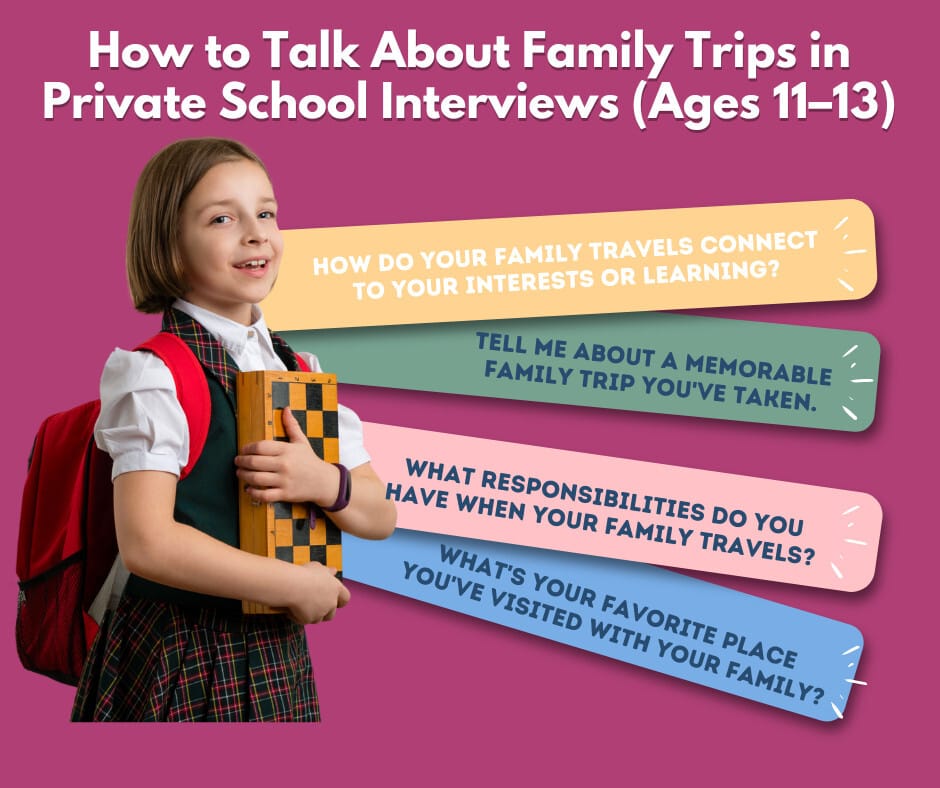
At this age, interviewers are looking for students who can:
- Speak thoughtfully about personal experiences
- Show connections between travel, academics, and personal growth
- Reflect on challenges and how they handled them
- Communicate future aspirations
Family travel is a fantastic topic to highlight all these traits.
Tips for Middle School Students:
- Focus on Growth: Share how trips helped you learn new skills or see things differently.
- Connect to Academics or Interests: Link experiences to school subjects, hobbies, or future goals.
- Acknowledge Challenges: It’s powerful to mention small struggles and how you overcame them.
- Stay Authentic: Speak honestly and warmly about what made the trip meaningful to you.
Red Flags to Avoid
- Focusing only on luxury aspects like hotels, shopping, or food, without depth
- Responses showing little connection to academics, interests, or personal growth
- Answers that sound rehearsed but lack real reflection (“It was fun because it was fun.”)
- Negative or superior attitudes toward other cultures or communities visited
3 Sample Conversations for the Private School Interview: Family Trips
Q1: “Tell me about a memorable family trip you’ve taken.”
Student: “We travel to Mexico every other year since my mom’s family lives there. I’m working on becoming fluent in Spanish, so these trips help me practice in real situations. I keep a journal in Spanish during our visits.”
Interviewer: “That’s wonderful that you get to visit Mexico regularly. What’s been your favorite experience during these family trips?”
Student: “I really love our visits to my grandmother’s hometown near Oaxaca. It’s so different from life here. The markets are amazing—full of colors, handmade crafts, and foods I never see at home. Last summer, my cousin taught me how to bargain in Spanish at the market, which was both fun and challenging!”
Interviewer: “It sounds like you’re getting some authentic language practice. Has maintaining this connection to your heritage influenced you in other ways?”
Student: “Definitely. I’ve started to appreciate traditional Mexican art more. My aunt is a weaver who creates beautiful textiles using natural dyes. She’s been teaching me some basic techniques during our visits. I actually brought some of her work to school for International Day last year and gave a presentation about the symbolism in the patterns.”
Interviewer: “That’s a great way to share your experiences with your school community. How do you maintain your Spanish skills between these trips?”
Student: “Besides my Spanish classes at school, I video chat with my cousins once a month. We started a book club where we read the same book—one month in English, one month in Spanish. It helps both of us improve our language skills. I also watch Mexican cooking shows with my mom on weekends, which has helped me learn kitchen vocabulary you don’t usually get in textbooks.”
Interviewer: “I’m impressed with your initiative! Looking ahead, how do you hope these experiences might shape your future?”
Student: “I’m really interested in becoming bilingual professionally. These trips have shown me how important cultural understanding is when communicating across languages. I’m considering international business or perhaps translation work someday. My grandfather worked as a tour guide, and hearing his stories about connecting people across cultural differences has inspired me.”
Interviewer: “Those sound like meaningful aspirations. One last question—what’s something challenging about these trips that you’ve had to overcome?”
Student: “Honestly, the first few days are always an adjustment for my Spanish. Even though I practice, there’s a period where my brain needs to switch gears. I used to get frustrated when I couldn’t express myself perfectly, but I’ve learned to be patient with myself. My relatives appreciate the effort more than perfect grammar, and that’s helped me become more confident about speaking, even when I make mistakes.”
Q2: “How do your family travels connect to your interests or learning?”
Student: “My most educational trip was to Washington D.C. last spring. We spent four days exploring the museums. The Air and Space Museum connected to my science project on flight, and I got to see actual moon rocks!”
Interviewer: “That sounds like a fascinating experience! What specifically about the Air and Space Museum connected with your science project?”
Student: “For my science project, I was researching how wing shapes affect lift and drag. At the museum, they had these amazing exhibits showing the evolution of aircraft design. I could actually see the Wright brothers’ original flyer and compare it to modern planes! There was an interactive display where I could test different wing designs in a wind tunnel—it really helped me understand the principles I’d been reading about.”
Interviewer: “It’s wonderful when you can see academic concepts come to life like that. Did any other museums leave an impression on you?”
Student: “Definitely! The Natural History Museum was incredible too. I’ve always been interested in geology, and they have this enormous collection of minerals and gems. The Hope Diamond was stunning, but I was actually more fascinated by the meteorite exhibit. It connected to what I learned about the moon rocks at Air and Space—it’s amazing to hold something in your hand that’s billions of years old and came from outer space!”
Interviewer: “You seem to have a strong interest in science. Has this trip influenced what you might want to study in the future?”
Student: “It really has. Before the trip, I was mostly interested in physics and flight. But after seeing the planetarium show at the Natural History Museum about space exploration, I’ve become really curious about astronomy too. I’ve started using a star-gazing app at night, and my parents got me a telescope for my birthday. I’m thinking about joining the astronomy club here if I’m accepted.”
Interviewer: “That’s excellent. Beyond the museums, did you experience anything else in Washington D.C. that was meaningful to you?”
Student: “Yes! We visited the Lincoln Memorial at sunset, which was beautiful. My dad is a history buff, so he told us stories about the Civil War and Lincoln’s leadership. It made me realize how important it is to stand up for what’s right, even when it’s difficult. We also saw Congress in session from the gallery, which made government seem more real than just reading about it in social studies class.”
Interviewer: “It sounds like you got a lot out of this trip. How do you usually prepare before visiting new places?”
Student: “My parents encourage us to research before trips. For D.C., each family member got to pick one must-see destination and become the ‘expert’ for that stop. I chose the Air and Space Museum, of course, so I read articles about their newest exhibits and made a list of questions I wanted to answer. My little sister chose the Zoo, and it was fun to see her take charge during that part of our visit. I think this approach makes our trips more meaningful than just rushing through tourist spots.”
Q3: “What responsibilities do you have when your family travels?”
Student: “Our family does a road trip each summer to different national parks. I’ve become our family’s unofficial photographer, documenting landscapes and wildlife. I’m responsible for researching hiking trails appropriate for our family’s skill level.”
Interviewer: “That’s a valuable contribution to your family trips. How do you prepare for your role as the family photographer?”
Student: “I actually take it pretty seriously! Before each trip, I study photos of the national park we’re visiting to understand the best viewpoints and lighting conditions. Last year before our trip to Yellowstone, I watched tutorials about wildlife photography since I really wanted to capture the bison and elk. My parents got me a decent camera for my birthday two years ago, and I’ve been learning how to use the manual settings instead of just automatic mode.”
Interviewer: “And what about your responsibility for researching hiking trails? What factors do you consider when making recommendations for your family?”
Student: “Safety comes first, especially since my younger brother is only eight. I check the elevation gain, total distance, and trail conditions. My mom has some knee issues, so I look for trails that aren’t too steep. I use the national park websites and hiking apps to find trails rated ‘moderate’ or easier, and I always check recent reviews to see if there are any warnings about trail closures or wildlife sightings. Then I create a document with 3-4 options and we vote as a family on which ones to do.”
Interviewer: “It sounds like you take these responsibilities seriously. Have there been any challenges or times when things didn’t go as planned?”
Student: “Definitely! Last summer at Glacier National Park, I recommended a trail that the app rated as ‘easy,’ but it turned out to be much more difficult than described. There had been a recent rainfall that made parts really muddy and slippery. My dad was carrying my brother on his shoulders by the end, and we all were exhausted. I felt pretty bad about it, but my parents said it was a good lesson in being adaptable and that sometimes nature doesn’t cooperate with our plans. Now I always have a backup option ready.”
Interviewer: “That’s a mature way to handle that situation. Has taking on these responsibilities affected you in other areas of your life?”
Student: “I think it’s made me more organized and thoughtful about planning ahead. This year, I was elected activities coordinator for my science club, and I use a similar approach—researching options, considering everyone’s abilities and interests, and preparing backup plans. I also think being the family photographer has taught me to really observe my surroundings and appreciate details I might have missed before. My science teacher says I have a good eye for observations during our lab experiments.”
Interviewer: “What’s been your favorite national park so far, and why?”
Student: “That’s tough! I think Zion National Park was my favorite because of how dramatically the landscape changes. The Narrows hike, where you actually walk through the river between these massive canyon walls, was incredible. The colors of the rock against the blue sky made for amazing photographs. I actually entered one of my sunset photos in a youth photography contest at our local library and won honorable mention. I’ve got my fingers crossed that my parents will choose Yosemite for next summer’s trip!”
Conclusion
For middle school students, family travel is more than a fun memory—it’s a chance to show personal development, connection to academics, and future goals during interviews.
Encourage students to reflect on how these experiences shaped who they are today. Being able to talk about learning from mistakes, growing independence, and gaining real-world knowledge will leave a strong, mature impression.
Family trips don’t have to be far or fancy—what matters is how students think about and grow from them.
How to Confidently Talk About Family Trips in Private School Interviews (Ages 5–10)
Preparing for Private School Interviews: Talking About Family Travel (Ages 14–18)