
Comparing Different Private School Philosophies: Finding the Right Fit for Your Child
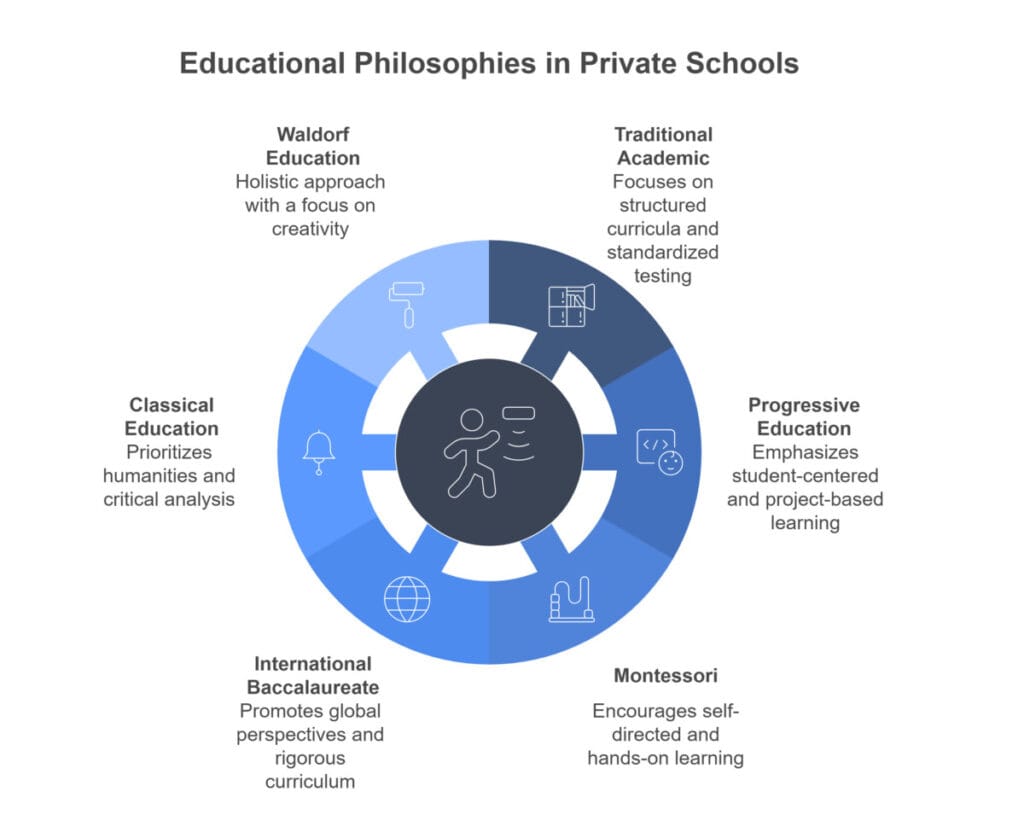
Choosing the right private school is more than just selecting an institution—it’s about finding an educational philosophy that resonates with your child’s learning style, personal growth, and future goals. Each philosophy offers a unique approach, shaping not only academic success but also character, critical thinking, and personal development.
Let’s explore the major private school philosophies to help you make an informed decision.
Contents
1. Traditional Academic Philosophy
Core Characteristics:
- Offers a structured and rigorous curriculum.
- Focuses on core academic subjects like mathematics, science, and literature.
- Prepares students for standardized testing and competitive college admissions.
- Utilizes hierarchical classroom management to maintain order and discipline.
- Sets clear expectations and emphasizes accountability.
Ideal For:
- Students who excel in structured environments
- Families who prioritize traditional academic excellence
- Children who thrive with clear guidelines and routines
- Preparation for competitive college admissions
Pros:
- Strong academic foundation
- Predictable learning environment
- Clear performance metrics
- Builds time management skills
Cons:
- Limited flexibility for individual learning styles
- May not suit creative or hands-on learners
- Potential for increased academic stress
Examples: Prep Schools and College Preparatory Academies
- Phillips Exeter Academy (USA)
- Known for its rigorous academic curriculum, Phillips Exeter offers a structured environment focused on traditional academic excellence. Its hallmark is the Harkness method, where students engage in discussion-based learning around a shared table. Students are challenged with a demanding workload designed to prepare them for Ivy League and other top-tier universities.
- Website: www.exeter.edu
- Raffles Institution (Singapore)
- As one of Singapore’s most prestigious schools, Raffles Institution combines a highly structured curriculum with a focus on excelling in standardized testing and national exams. It is an excellent choice for students aiming for academic distinction and a strong foundation in mathematics, science, and languages.
- Website: www.ri.edu.sg
- St. Paul’s School (UK)
- A historic preparatory school in London, St. Paul’s is known for its academic rigor and discipline. The school balances a demanding curriculum with a focus on fostering leadership and critical thinking, preparing students for top universities worldwide.
- Website: www.stpaulsschool.org.uk
- Eton College (UK)
- One of the most renowned schools globally, Eton College upholds traditional academic values with an emphasis on classical subjects, discipline, and leadership development. Alumni include British prime ministers and global leaders, reflecting the school’s legacy of excellence.
- Website: www.etoncollege.com
- The Lawrenceville School (USA)
- Located in New Jersey, Lawrenceville blends traditional academic rigor with modern teaching methods. Its structured curriculum emphasizes discipline and preparation for higher education, making it a preferred choice for families seeking a balance between traditional values and contemporary education.
- Website: www.lawrenceville.org
- Horace Mann School (USA)
- Situated in New York City, Horace Mann offers a highly competitive academic environment focused on traditional disciplines like STEM, literature, and history. The school is known for preparing students for success in prestigious universities.
- Website: www.horacemann.org
- The Perse School (UK)
- Based in Cambridge, The Perse School combines traditional academic subjects with an emphasis on exam preparation and intellectual development. Its approach is structured and goal-oriented, ensuring students excel in both national and international contexts.
- Website: www.perse.co.uk
- Stuyvesant High School (USA)
- While a public school, Stuyvesant epitomizes traditional academic excellence with its rigorous STEM-focused curriculum. The school fosters a disciplined environment, perfect for students who thrive under high academic expectations.
- Website: www.stuy.edu
- Lycée Louis-le-Grand (France)
- Situated in Paris, this prestigious school is recognized for its rigorous classical curriculum, preparing students for France’s Grandes Écoles. With a focus on mathematics, sciences, and humanities, it exemplifies traditional academic values.
- Website: www.louislegrand.org
- Singapore American School (Singapore)
- While blending some international elements, this institution maintains a structured academic environment emphasizing core disciplines, standardized testing, and preparation for college admissions.
- Website: www.sas.edu.sg
2. Progressive Education Philosophy
Core Characteristics:
- Prioritizes student-centered learning tailored to individual needs.
- Encourages collaboration through real-world, project-based activities.
- Adopts an experiential and interdisciplinary teaching approach.
- Promotes critical thinking and problem-solving skills.
- Focuses on fostering curiosity and learning driven by personal interests.
Ideal For:
- Curious, self-motivated learners
- Students who enjoy project-based learning
- Families who value holistic development
- Children with diverse learning styles
Pros:
- Fosters independent thinking and creativity
- Builds problem-solving skills
- Adapts to individual student needs
Cons:
- Less structured academic progression
- Potential gaps in traditional subject mastery
- May require more parental involvement
Examples: Schools Focusing on Student-Centered, Experiential Learning
- Reggio Emilia Schools (Italy)
- Known globally for its child-centered, project-based approach, Reggio Emilia schools foster creativity, critical thinking, and collaborative learning through self-directed, hands-on activities.
- Website: www.reggiochildren.it
- High Tech High (USA)
- Based in San Diego, California, High Tech High uses a project-based learning model to engage students in interdisciplinary, real-world problems, emphasizing creativity and collaboration.
- Website: www.hightechhigh.org
- The Nueva School (USA)
- Located in California, this progressive school emphasizes experiential learning, design thinking, and social-emotional development. Students explore interdisciplinary projects in innovative and supportive settings.
- Website: www.nuevaschool.org
- Summerhill School (UK)
- Founded by A.S. Neill, Summerhill offers a democratic approach to education, allowing students to take charge of their own learning and engage in activities they are passionate about.
- Website: www.summerhillschool.co.uk
- Quest to Learn (USA)
- A New York-based school designed around game-based learning, Quest to Learn encourages students to solve challenges through interactive, team-oriented projects and digital tools.
- Website: www.q2l.org
- Green School (Indonesia)
- Situated in Bali, this unique progressive school integrates environmental sustainability with experiential education, offering classes in bamboo-built classrooms surrounded by nature.
- Website: www.greenschool.org
- Albany Free School (USA)
- Located in New York, the Albany Free School is rooted in progressive education principles, allowing students to pursue their interests and learn through exploration and community engagement.
- Website: www.albanyfreeschool.org
- Brooklyn Collaborative (USA)
- A progressive public school in New York City that emphasizes inquiry-based learning and interdisciplinary projects, preparing students for both college and civic life.
- Website: www.bcs448.org
- Sidwell Friends School (USA)
- Known for its Quaker roots, this school emphasizes inquiry-based learning and student-centered projects, fostering intellectual curiosity and social responsibility.
- Website: www.sidwell.edu
- Francis W. Parker School (USA)
- Based in Chicago, Parker School embodies the ideals of progressive education, focusing on student individuality, critical thinking, and preparing learners for active citizenship.
- Website: www.fwparker.org
- Wellington College (UK)
- While rooted in tradition, Wellington incorporates progressive education principles, emphasizing holistic development, creativity, and well-roundedness in its approach.
- Website: www.wellingtoncollege.org.uk
- Brightworks (USA)
- Located in San Francisco, this progressive school is known for its exploratory learning philosophy, where students tackle ambitious, multi-disciplinary projects.
- Website: www.sfbrightworks.org
- LEAP School (South Africa)
- Focused on experiential learning and community involvement, LEAP combines progressive education with a commitment to social justice and addressing educational disparities.
- Website: www.leapschool.org.za
- Blue School (USA)
- Founded by the creators of the Blue Man Group in New York City, this innovative school blends creativity, play, and inquiry-based learning into its curriculum.
- Website: www.blueschool.org
- The Putney School (USA)
- A progressive boarding school in Vermont that emphasizes hands-on learning, sustainability, and arts integration, empowering students to think critically and act responsibly.
- Website: www.putneyschool.org
- Project-Based Learning Network Schools (Global)
- Many progressive schools globally embrace the Buck Institute for Education’s PBLWorks framework, fostering inquiry-driven learning across diverse settings.
- Website: www.pblworks.org
3. Montessori Philosophy
Core Characteristics:
- Provides child-directed, self-paced learning opportunities.
- Features mixed-age classrooms that encourage peer learning and collaboration.
- Empowers students through hands-on, sensory-based exploration.
- Emphasizes the development of practical life skills for independence and self-reliance.
Ideal For:
- Young learners (especially pre-K to elementary)
- Children who are self-motivated and independent
- Students who learn best through physical exploration
Pros:
- Encourages intrinsic motivation and curiosity
- Builds independence and confidence
- Allows individualized learning pace
Cons:
- Challenging transition to traditional schools
- Limited availability in higher grades
- Higher tuition costs in some cases
Examples: Authentic Montessori Schools and Global Impact
- Montessori School of Tokyo (Japan)
- This internationally acclaimed Montessori institution focuses on child-directed learning with a global perspective. It incorporates practical life skills, sensory activities, and cultural education to nurture independence and creativity.
- Website: www.montessorijapan.com
- Maria Montessori Institute (UK)
- Located in London, this school combines the traditional Montessori method with a focus on urban life skills. Mixed-age classrooms and hands-on materials help children explore at their own pace.
- Website: www.mariamontessori.org
- International Montessori School (Belgium)
- Known for its multilingual programs, this school emphasizes cultural diversity alongside the Montessori approach. It provides a unique environment where children can learn in multiple languages.
- Website: www.international-montessori.org
- The NewGate School (USA)
- Situated in Florida, this Montessori school is often referred to as “The Montessori Foundation’s Lab School.” It implements authentic Montessori practices, catering to students from infancy through high school.
- Website: www.newgate.edu
- Montessori de la Condesa (Mexico)
- A well-regarded Montessori institution in Mexico City, this school emphasizes bilingual education and hands-on activities. It encourages creativity and practical life skills in a warm, supportive environment.
- Website: www.montessoridelacondesa.com
- Montessori Lyceum Amsterdam (Netherlands)
- This innovative school combines Montessori principles with secondary education, providing students the freedom to explore academic subjects at their own pace.
- Website: www.montessorilyceum.nl
- Baan Dek Montessori (USA)
- Located in South Dakota, Baan Dek focuses on early childhood education. The school’s mission is to create a nurturing, child-centered environment where independence thrives.
- Website: www.baandek.org
- Montessori East (Australia)
- Based in Sydney, this school emphasizes the connection between practical learning and the natural environment. It integrates Montessori principles with a strong focus on environmental sustainability.
- Website: www.montessori.nsw.edu.au
- EtonHouse International Education Group (Global)
- With schools across Asia, EtonHouse incorporates Montessori methods for early learners. These schools emphasize inquiry-based learning alongside the Montessori model.
- Website: www.etonhouse.com
- Oak Knoll Montessori School (USA)
- Located in Georgia, this school is known for its vibrant community and dedication to fostering curiosity. It blends Montessori practices with outdoor education to encourage holistic growth.
- Website: www.oakknollmontessori.com
4. International Baccalaureate (IB) Philosophy
Core Characteristics:
- Promotes a global perspective and intercultural understanding.
- Offers a rigorous, internationally recognized curriculum suitable for university preparation.
- Incorporates service-learning components to foster civic engagement.
- Focuses on both personal and academic growth, encouraging well-rounded development.
Ideal For:
- Globally-minded students
- Families valuing international exposure
- Students interested in cross-cultural experiences
Pros:
- Develops global citizenship and critical thinking
- Strong university preparation
- Internationally recognized credentials
Cons:
- Intense academic workload
- Potentially high-stress environment
- Requires significant commitment
Examples: Global Schools Offering the IB Curriculum
- United World College (UWC) Network (Global)
- With campuses in 18 countries, UWC schools emphasize the IB curriculum’s global perspective. These institutions focus on fostering intercultural understanding and preparing students for leadership roles in an interconnected world.
- Website: www.uwc.org
- International School of Geneva (Switzerland)
- As the birthplace of the IB program, this school has a long-standing tradition of academic excellence and global citizenship. Students benefit from a rigorous curriculum complemented by diverse extracurricular opportunities.
- Website: www.ecolint.ch
- The Aga Khan Academies (Global)
- With campuses across Africa, Asia, and the Middle East, these schools integrate the IB curriculum with cultural education and service-learning projects. They emphasize leadership and ethical responsibility.
- Website: www.agakhanacademies.org
- St. Clare’s, Oxford (UK)
- Located in the academic city of Oxford, this IB World School is renowned for its high-achieving students who often go on to prestigious universities worldwide. The school blends the IB curriculum with an emphasis on critical thinking and cultural exchange.
- Website: www.stclares.ac.uk
- Hong Kong Academy (Hong Kong)
- This non-profit school offers all three IB programs (PYP, MYP, and DP), ensuring a seamless progression from primary to pre-university education. Its curriculum is enriched with service-learning and sustainability initiatives.
- Website: www.hkacademy.edu.hk
- International School of Manila (Philippines)
- With a focus on the IB Diploma Programme, this school combines academic rigor with extracurricular activities, preparing students for success in global universities. It boasts a strong community-oriented culture.
- Website: www.ismanila.org
- Jerudong International School (Brunei)
- Known for its commitment to academic excellence, this school integrates the IB curriculum with diverse extracurricular programs. Its emphasis on intercultural understanding aligns well with the IB philosophy.
- Website: www.jerudonginternationalschool.com
- American School of Dubai (UAE)
- This IB World School combines the IB curriculum with American educational practices, offering students a globally recognized qualification while maintaining a focus on innovation and leadership.
- Website: www.asdubai.org
- Canadian International School (Singapore)
- This school offers all levels of the IB program, from primary to diploma. It is known for its emphasis on multilingualism and a strong sense of community among its international students.
- Website: www.cis.edu.sg
- IB School 50 (India)
- Located in Mumbai, this school highlights the IB’s interdisciplinary approach and integrates local cultural elements to provide students with a well-rounded, globally focused education.
- Website: www.ibschool50.com
- ISF Academy (Hong Kong)
- Combining the IB curriculum with Chinese cultural education, this school provides a bilingual environment that nurtures academic excellence and global awareness.
- Website: www.isf.edu.hk
- Munich International School (Germany)
- Situated in a historic city, this school offers the IB curriculum within a multicultural setting. It focuses on developing independent learners and fostering a spirit of innovation.
- Website: www.mis-munich.de
- NIST International School (Thailand)
- Based in Bangkok, NIST is one of Southeast Asia’s leading IB schools. It emphasizes experiential learning, creativity, and critical thinking as core elements of its educational philosophy.
- Website: www.nist.ac.th
- Ruamrudee International School (Thailand)
- This school integrates the IB curriculum with a strong focus on community service and moral responsibility, encouraging students to think beyond academics.
- Website: www.rism.ac.th
- Western Academy of Beijing (China)
- A top-tier IB World School in Asia, WAB combines the IB curriculum with cutting-edge technology and a focus on individual student growth.
- Website: www.wab.edu
5. Classical Education Philosophy
Core Characteristics:
- Draws from ancient Greek and Roman educational principles.
- Prioritizes the study of humanities, including literature, philosophy, and history.
- Employs a systematic learning model based on the Trivium (grammar, logic, and rhetoric).
- Emphasizes critical analysis, logical reasoning, and rhetorical skills.
- Nurtures a deep understanding of historical context and cultural heritage.
Ideal For:
- Students interested in humanities and philosophy
- Families valuing historical and cultural studies
- Children who thrive in structured, language-focused learning
Pros:
- Builds advanced communication and analytical skills
- Develops a strong foundation in critical thinking
- Offers rich historical and cultural perspectives
Cons:
- Limited focus on modern technological skills
- Can feel outdated for some learners
Examples: Schools Offering Rigorous Classical Curricula
- The Great Hearts Academies (USA)
- This network of public charter schools specializes in the classical education model, focusing on the Trivium (grammar, logic, and rhetoric) and offering a rich humanities-based curriculum. Students engage in Socratic discussions and study classical languages such as Latin and Greek.
- Website: www.greatheartsamerica.org
- Thomas Aquinas College (USA)
- Known for its liberal arts program rooted in classical philosophy and theology, this college also inspires secondary schools with its commitment to Socratic dialogue and the study of Great Books.
- Website: www.thomasaquinas.edu
- King’s College School, Wimbledon (UK)
- While offering a modern curriculum, this school incorporates classical elements such as Latin and Greek studies, emphasizing logical reasoning and rhetoric as critical components of a well-rounded education.
- Website: www.kcs.org.uk
- The Lyceum (USA)
- A private Catholic school in Ohio that blends a rigorous classical curriculum with a faith-based approach, offering deep engagement with classical texts and languages.
- Website: www.lyceum.org
- Trivium School (USA)
- Located in Massachusetts, Trivium School exemplifies the classical education model by providing an intellectually rigorous curriculum steeped in philosophy, literature, and history.
- Website: www.triviumschool.com
- Paideia Academy (USA)
- Based in Tennessee, this school integrates Christian faith with classical education principles, focusing on the study of Western civilization and critical thinking skills.
- Website: www.paideiaacademy.org
- St. John’s College (USA)
- Although a university, its Great Books program influences many classical high schools. Students focus on original texts from Plato, Aristotle, and Shakespeare, applying the same principles in secondary education.
- Website: www.sjc.edu
- Scholae Academy (Australia)
- A classical Christian school that emphasizes the study of history, philosophy, and logic through the Trivium framework. Students are encouraged to think critically and engage in respectful discourse.
- Website: www.scholaeacademy.com
- The Geneva School (USA)
- Located in Florida, this private Christian school adopts the classical education model by integrating faith and reason, encouraging students to think deeply and communicate effectively.
- Website: www.genevaschool.org
- Le Rosey (Switzerland)
- Known as the “School of Kings,” Le Rosey integrates classical education principles with modern curricula, emphasizing critical thinking, logic, and cultural appreciation.
- Website: www.rosey.ch
- The Ambrose School (USA)
- This Idaho-based institution offers a K–12 classical Christian education focused on cultivating wisdom and virtue through the Great Books and classical languages.
- Website: www.theambroseschool.org
- Clonlara School (Ireland)
- Combining classical education with personalized learning plans, this school emphasizes critical thinking and the study of enduring works in literature and philosophy.
- Website: www.clonlara.org
- Classical Preparatory School (USA)
- A charter school in Florida that uses the classical model to nurture critical thinking and leadership skills, ensuring students are well-prepared for higher education.
- Website: www.classicalprep.org
- The Academy of Classical Christian Studies (USA)
- Based in Oklahoma, this school emphasizes the classical approach in a Christian context, focusing on logic, rhetoric, and the Great Books of Western civilization.
- Website: www.theacademyok.org
- Kolbe Academy (USA)
- A classical Catholic school offering both in-person and online programs, Kolbe Academy provides a rigorous curriculum emphasizing theology, philosophy, and the classics.
- Website: www.kolbe.org
6. Waldorf Education Philosophy
Core Characteristics:
- Adopts a holistic, developmental approach to education.
- Cultivates creativity and a love for arts and imaginative thinking.
- Limits technology use in the early years to enhance sensory and creative learning.
- Emphasizes whole-child development, integrating emotional, social, and academic growth.
Ideal For:
- Families valuing artistic and emotional development
- Students with strong creative inclinations
- Children who thrive in nature-connected learning
Pros:
- Nurtures creativity and emotional intelligence
- Reduces early academic pressure
- Focuses on holistic development
Cons:
- Limited early exposure to technology
- Less structured academic progression
Examples: Schools Emphasizing Arts, Creativity, and Nature-Based Learning
- Rudolf Steiner School (USA)
- Located in New York City, this school follows the Waldorf philosophy founded by Rudolf Steiner. It emphasizes artistic integration, hands-on learning, and minimal technology, fostering a deep connection with imagination and creativity.
- Website: www.steiner.edu
- Michael Hall Steiner Waldorf School (UK)
- One of the first Waldorf schools in England, it offers a curriculum rich in artistic and experiential learning, promoting whole-child development and strong social-emotional skills.
- Website: www.michaelhall.co.uk
- Seattle Waldorf School (USA)
- A leader in Waldorf education on the West Coast, this school integrates arts, movement, and nature into its curriculum, offering an engaging and holistic educational approach.
- Website: www.seattlewaldorf.org
- Green Meadow Waldorf School (USA)
- Located in New York, Green Meadow emphasizes creative expression, hands-on learning, and a strong sense of community, with activities like woodworking, knitting, and gardening.
- Website: www.gmws.org
- International Waldorf School of Lyon (France)
- A bilingual Waldorf school offering programs that blend artistic activities, academic rigor, and a strong connection to nature, fostering students’ individuality.
- Website: www.waldorflyon.org
- Vancouver Waldorf School (Canada)
- This school emphasizes creativity and experiential learning through arts, music, and storytelling while incorporating a nature-based curriculum that connects children with the environment.
- Website: www.vancouverwaldorfschool.com
- Tridhara Waldorf School (India)
- Focused on holistic development, this school blends the Waldorf approach with Indian cultural traditions, emphasizing rhythmic learning, artistic expression, and ecological awareness.
- Website: www.tridharawaldorf.org
- Waldorf School of Orange County (USA)
- Situated in California, this school integrates art, music, and movement into its curriculum, fostering creativity while maintaining a balance with academic disciplines.
- Website: www.waldorfschool.com
- Freie Waldorfschule Berlin-Mitte (Germany)
- One of Germany’s many Waldorf schools, it offers a curriculum deeply rooted in Steiner’s philosophy, emphasizing creativity, craftsmanship, and a connection to cultural heritage.
- Website: www.waldorf-berlin-mitte.de
- Samford Valley Steiner School (Australia)
- Located near Brisbane, this school emphasizes a Waldorf curriculum enriched with arts, crafts, and outdoor activities, cultivating creative and confident learners.
- Website: www.samfordsteiner.qld.edu.au
- Kusi Kawsay (Peru)
- A Waldorf-inspired school integrating the cultural heritage of the Andes with Steiner’s principles, it fosters holistic education through art, community involvement, and respect for nature.
- Website: www.kusikawsay.org
- Emerson Waldorf School (USA)
- Located in North Carolina, Emerson Waldorf encourages artistic exploration and creative problem-solving while integrating practical skills like gardening and woodworking.
- Website: www.emersonwaldorf.org
- Aurora Waldorf School (USA)
- This New York-based school emphasizes the connection between the arts, nature, and academics, encouraging students to develop a lifelong love of learning.
- Website: www.aurorawaldorfschool.org
- Waldorf International School (Thailand)
- Offering a global Waldorf perspective, this school incorporates experiential learning, artistic activities, and cultural studies into its curriculum.
- Website: www.waldorfthailand.org
- Cape Byron Steiner School (Australia)
- This school in Byron Bay integrates the Waldorf philosophy with a strong focus on environmental stewardship, offering programs rich in arts, movement, and outdoor learning.
- Website: www.capebyronsteiner.nsw.edu.au
- The Waldorf School of Garden City (USA)
- This Long Island-based institution integrates art, music, and physical activity with academics, promoting emotional intelligence and individuality in a supportive community.
- Website: www.waldorfgarden.org
Conclusion:
Education is not a one-size-fits-all journey. Choosing the right school philosophy is about finding an environment that not only fosters academic growth but also cultivates your child’s curiosity, creativity, and unique potential. Whether your child thrives in structured settings, embraces hands-on exploration, or flourishes in holistic, interdisciplinary approaches, there is a school philosophy tailored to their needs. Take the time to explore these options thoroughly, visit schools, and engage in meaningful discussions with educators and your child. By involving them in the decision-making process, you empower them to feel confident and excited about their educational journey. The ultimate goal is to select a school where your child feels supported, inspired, and ready to thrive in all aspects of their development.